

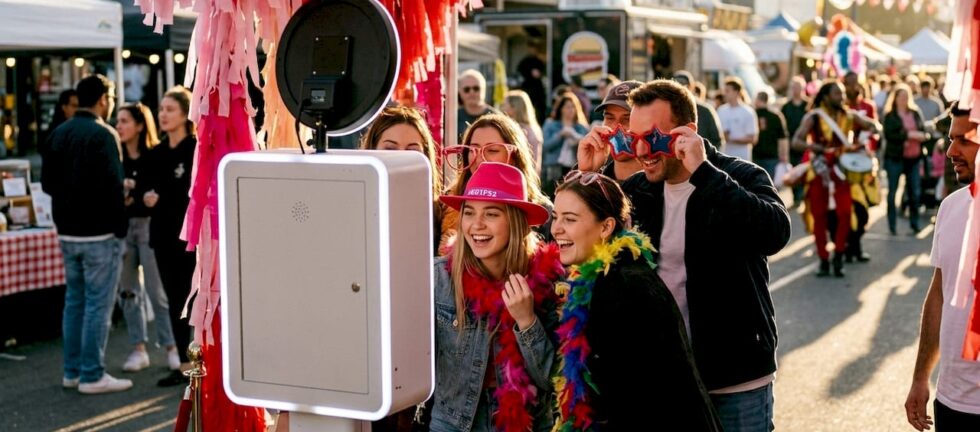
Photo booths are defined as interactive photography stations that give event guests instant, shareable images, and their role at large-scale events has expanded well beyond entertainment. The industry term for this type of activation is a “photo booth experience,” and it now functions as a measurable marketing tool alongside its original purpose as party entertainment. Corporate activations achieve a cost-per-lead as low as $3–$6, compared to $25–$50 for paid social media advertising. That gap makes photo booths one of the most cost-efficient engagement tools available to event planners today. ZATTU PHOTO BOOTH, based in Southwestern Ontario, builds activations around Nikon full-frame mirrorless cameras and professional lighting to deliver studio-quality results at weddings, galas, corporate functions, and community gatherings.
How do photo booths enhance guest experience at large events?
Photo booths generate engagement because they give guests something active to do, not just something passive to watch. Events with photo booths see higher attendance, longer engagement, and increased social shares, turning brief moments into genuine networking opportunities. That combination of fun and function is why photo booth party entertainment has become a standard line item in large-scale event budgets.
The features that drive participation include:
- Instant digital sharing via QR code. Guests scan a code and receive their photo within seconds. QR sharing generates 3–5 times more social distribution than print-only formats, which means your event reaches audiences who were never in the room.
- Branded overlays and custom templates. Every image carries the event’s visual identity, whether that is a wedding monogram, a corporate logo, or a school dance theme. Consistent branding across hundreds of shared images builds recall without additional ad spend.
- Props and themed backdrops. Physical props lower social inhibition and encourage group photos. How photo booth themes work at events is straightforward: a cohesive visual environment gives guests permission to be playful, which increases time spent at the activation.
- AI-powered filters and glam effects. A glam filter photo booth applies studio-style retouching in real time, producing polished images guests are proud to share publicly.
Pro Tip: Place the booth near a high-traffic area like the bar or registration desk, not tucked in a corner. Visibility drives spontaneous participation far more effectively than signage alone.
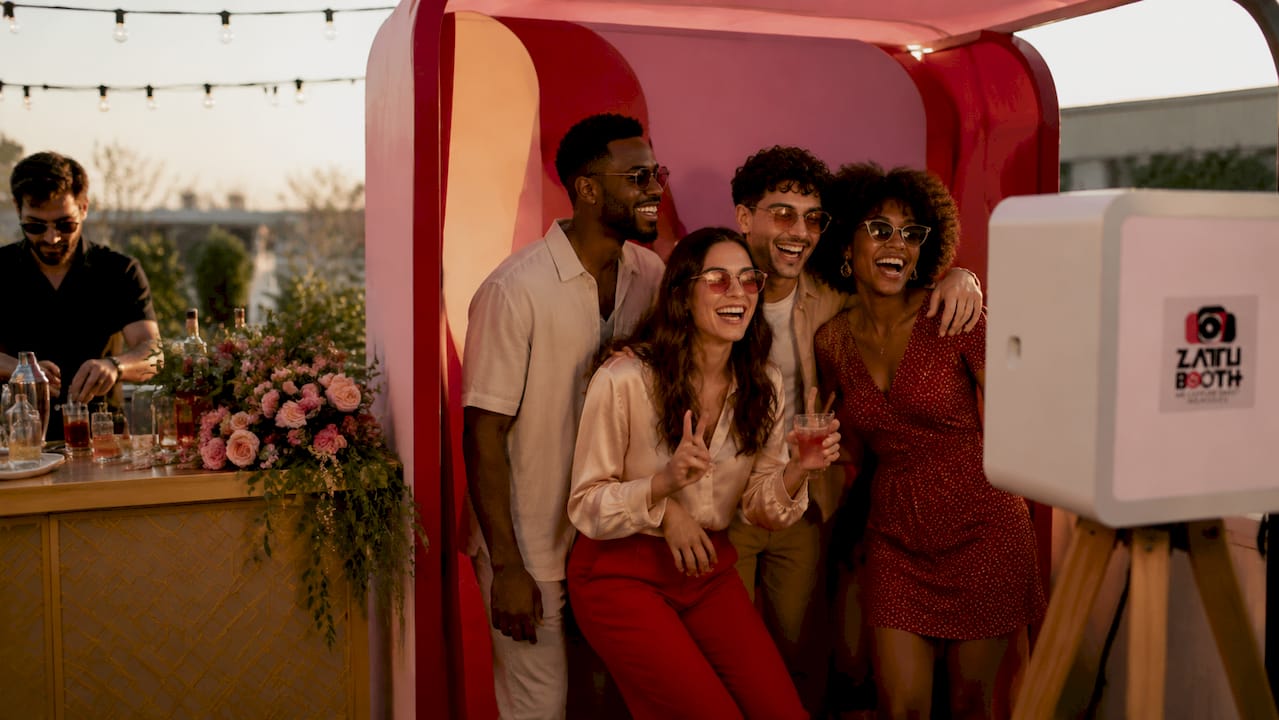
What operational planning does a large-scale photo booth deployment require?
Logistics separate a successful activation from a visible failure point. Getting the planning right before the event date is the single most important thing you can do.
- Book early. Standard corporate events require 6–8 weeks of lead time; peak seasons demand 8–12 weeks. Rushing this timeline leads to compromised branding, limited equipment availability, and rushed creative approvals.
- Allow time for brand approval. Custom photo booth creative requires 4–6 weeks for brand approval, with peak-season bookings needing the full 8–12 weeks. Late approvals force rushed revisions that show up in the final product.
- Calculate booth capacity accurately. Divide your total guest count by the number of activation hours, then add a 20% buffer to keep wait times manageable. A queue longer than 4 minutes causes guest disengagement and line abandonment, which creates a visible failure point at your event.
- Deploy multiple stations at large events. Events with over 5,000 attendees need at least 2–3 distributed photo booth stations to avoid bottlenecks. Spreading stations across the venue also drives foot traffic to areas that might otherwise feel underused.
- Plan for connectivity. Corporate venues often restrict WiFi networks, which blocks digital sharing features. Require your vendor to supply a dedicated cellular hotspot as part of the rental agreement.
Pro Tip: Ask your vendor for an attendee-per-hour throughput figure for each booth type before you sign. That number tells you exactly how many stations you need, and it protects you from overpromising to your client.
Which photo booth formats work best for large-scale event goals?
Different formats serve different objectives. Choosing the right one depends on whether your priority is brand visibility, guest entertainment, lead capture, or social amplification.
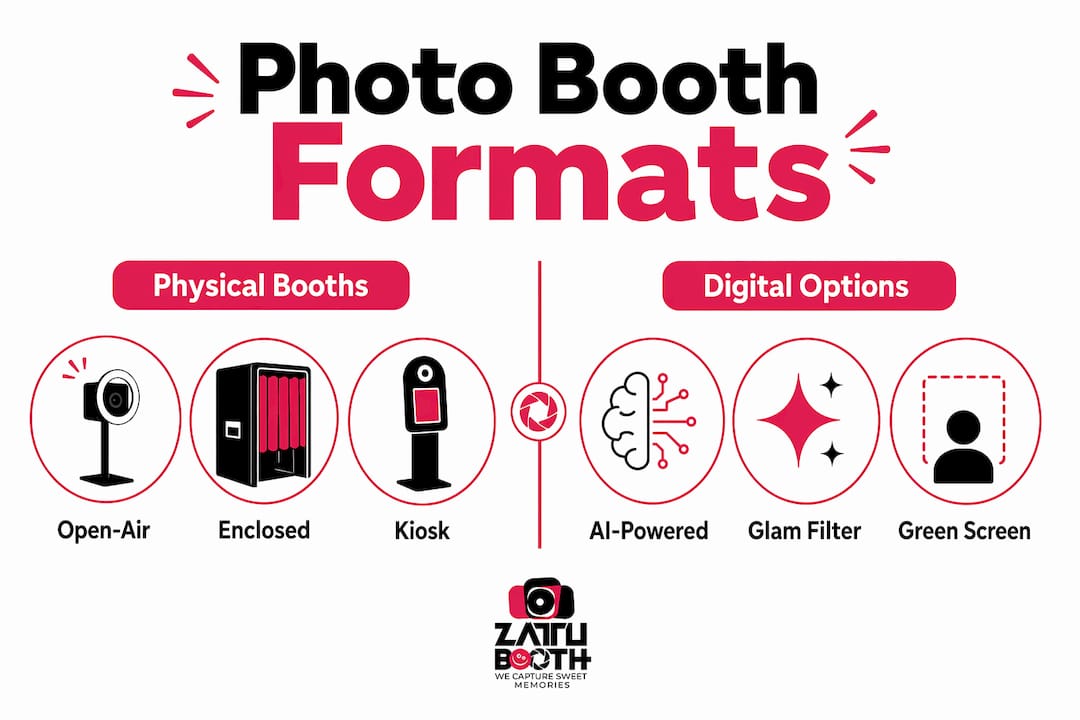
| Format | Best for | Key advantage |
|---|---|---|
| AI-powered booth | High-throughput events, corporate | Processes outputs in under 4 seconds, minimising wait times |
| Open-air studio booth | Weddings, birthday parties, galas | Accommodates large groups, flexible backdrop options |
| 360 video booth | Brand launches, charity galas | Creates spectacle moments with high shareability |
| Glam filter booth | School dances, milestone birthdays | Studio-style retouching drives pride in sharing |
| Roaming booth | Community gatherings, large receptions | Reaches guests who never visit a fixed station |
The AI photo booth stands out for events where throughput matters most. Processing time of 10–15 seconds in some AI formats also creates a brief window that functions as ad inventory for brand messaging, displaying sponsor content or event branding while guests wait for their image.
For photo booth corporate event planning, the open-air format remains the most versatile default. It handles groups of 10 or more, works with any backdrop, and supports both print and digital delivery. The 360 video booth is the right choice when you need a centrepiece moment that generates video content rather than still images.
Prints versus digital delivery is a genuine trade-off. Prints create tangible keepsakes guests take home, which extends brand exposure beyond the event. Digital sharing via QR code multiplies social reach by distributing images to networks your event never directly reached. For most large events, offering both options produces the strongest combined result.
How do photo booths maximise marketing ROI at large events?
Photo booths are content engines. Every image a guest shares carries your event’s branding to their personal network, generating impressions that paid advertising cannot replicate at the same cost.
The numbers are clear. Corporate photo booth activations achieve a cost-per-lead as low as $3–$6, compared to a paid social media average of $25–$50 per lead. That is an 8–16x cost advantage. For event planners who need to justify budget to stakeholders, that figure is the most persuasive data point available.
To maximise that return, treat the photo booth activation as a content campaign rather than a standalone attraction:
- Require branded overlays on every image. A logo or event hashtag on every shared photo creates consistent, repeated impressions across every guest’s social network.
- Capture data at the point of sharing. Digital delivery workflows collect email addresses or phone numbers when guests request their image. That list becomes a post-event marketing asset.
- Use post-event analytics. Quality vendors provide share counts, image delivery rates, and social reach data. Present these figures to stakeholders as proof of engagement value, not just entertainment spend.
- Align the activation with your event’s content strategy. A product launch benefits from a branded AI booth with custom filters tied to the product. A charity gala benefits from a glam booth that makes guests feel celebrated and generous.
The shift toward treating photo booths as measurable content engines with social amplification and lead capture as primary metrics is the defining trend of 2026. Planners who understand this position themselves well ahead of those still treating the booth as a novelty add-on.
Key takeaways
Photo booths deliver measurable marketing ROI and guest engagement at large-scale events when deployed with the right format, sufficient capacity, and a clear content strategy.
| Point | Details |
|---|---|
| Book with lead time | Standard events need 6–8 weeks; peak seasons require 8–12 weeks to avoid rushed branding. |
| Match format to goal | AI booths maximise throughput; 360 booths create spectacle; open-air booths handle large groups. |
| Plan capacity carefully | Add a 20% buffer to your throughput calculation and deploy 2–3 stations for events over 5,000 guests. |
| Treat sharing as marketing | QR delivery generates 3–5x more social reach than print-only and captures guest data for follow-up. |
| Measure and report | Share counts, delivery rates, and cost-per-lead data turn entertainment spend into provable ROI. |
What I’ve learned about photo booths and large-scale events
Most planners still book a photo booth the same way they book a balloon arch. They think about it late, treat it as décor, and measure success by whether the queue moved. That approach leaves most of the value on the table.
What I’ve seen working with events across Southwestern Ontario is that the booths generating the most impact are the ones planned like a media buy. The organiser knows the target impression count before the event starts. They’ve approved the branded overlay four weeks out. They’ve confirmed the cellular hotspot is in the vendor’s kit. Those events walk away with a data report, not just a memory card.
The other thing I’d push back on is the assumption that photo booths are only for corporate events or weddings. School dance photo booth logistics are genuinely different from a 10,000-person conference, but the planning discipline is identical. You still need to calculate throughput, confirm connectivity, and brief your attendant on managing flow. The scale changes; the principles don’t.
Guest expectations have shifted too. People in 2026 expect a digital image in their inbox within 60 seconds of taking the photo. Print is a bonus, not the baseline. If your vendor’s workflow still centres on a physical print queue, you’re offering an experience that feels dated before the night is over.
The booths that earn repeat bookings are the ones where the planner treated the activation as a product, not a prop.
— George ZATTU
ZATTU PHOTO BOOTH for large-scale event activations
ZATTU PHOTO BOOTH offers a full range of formats built for high-volume events across Kitchener, Waterloo, Guelph, Hamilton, and the surrounding region. Every rental includes studio-grade Nikon full-frame mirrorless cameras, professional lighting, and custom-designed overlays aligned to your event’s branding. Our team handles setup, staffing, and digital delivery so you can focus on running the event.
Whether you’re planning a corporate gala, a wedding reception, or a community fundraiser, we match the right booth format to your guest count and goals. Our party photo booth rentals cover everything from intimate birthday parties to large-scale community events, and our corporate rental options include full branding packages with post-event analytics. Request a quote and we’ll respond within one business day.
FAQ
What is the role of photo booths at large-scale events?
Photo booths serve as interactive engagement stations that generate shareable branded content and capture guest data. At large events, they function as both entertainment and a measurable marketing tool.
How many photo booth stations do I need for a large event?
Events with over 5,000 attendees require at least 2–3 distributed stations to prevent queues exceeding 4 minutes. Calculate capacity by dividing guest count by activation hours, then add a 20% buffer.
How far in advance should I book a photo booth for a corporate event?
Standard corporate events require 6–8 weeks of lead time; peak-season events need 8–12 weeks. This timeline covers branding approvals, equipment reservation, and creative revisions.
What is a glam filter photo booth?
A glam filter photo booth applies real-time studio-style retouching to images, producing polished, high-contrast photos that guests are confident sharing publicly. It is a popular choice for galas, milestone birthdays, and school dances.
How do photo booth rentals work at parties and large gatherings?
A vendor delivers and sets up the booth before the event, staffs it during the activation, and handles digital delivery to guests via QR code or email. Most rentals include a custom-branded overlay, props, and a post-event image gallery.