

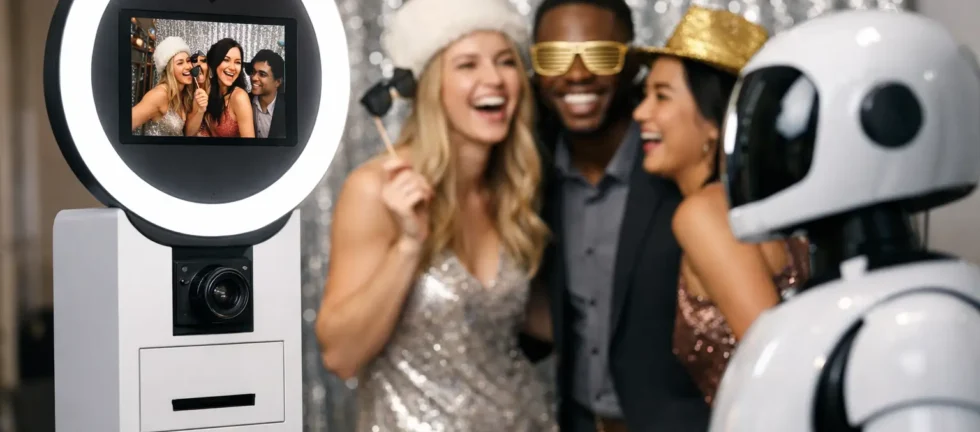
A packed dance floor is great. A line forming at the photo booth before dinner is even better, because it tells you guests are already engaged. That is exactly why this ai photo booth guide matters. When it is done well, an AI photo booth is not just another novelty at the side of the room. It becomes a conversation starter, a personalized keepsake station, and one of the easiest ways to give guests something fun to do without forcing the moment.
The catch is that not every AI photo booth experience feels premium. Some produce gimmicky results that guests try once and forget. Others create genuinely polished images people share, print, and talk about long after the event. The difference usually comes down to setup, image quality, lighting, customization, and the team running it.
What an AI photo booth actually does
At the simplest level, an AI photo booth uses artificial intelligence to transform, stylize, or personalize guest photos in real time. That can mean themed portraits, branded overlays, creative background changes, or artistic effects that go beyond a standard snapshot. For weddings, that might look like elegant stylized portraits that still flatter the guest. For corporate events, it might mean branded image treatments that feel tied to the event rather than random.
That flexibility is the appeal. A traditional booth captures the moment as it is. An AI booth adds a layer of imagination on top of it. Guests are not only taking pictures – they are seeing themselves reinterpreted in a way that feels playful, surprising, and shareable.
Still, there is a big difference between AI as a feature and AI as the whole product. If the camera is weak, the lighting is flat, or the prints look cheap, no amount of software magic fixes that. AI works best when it starts with a strong original image.
AI photo booth guide: what separates premium from gimmicky
This is where many event hosts get burned. They hear “AI photo booth” and assume every provider is offering roughly the same thing. They are not.
A premium experience starts with real photography fundamentals. Strong camera bodies, professional lenses, and controlled lighting matter because AI output is only as good as the photo it receives. If the booth is using tablet hardware, mixed room lighting, or inconsistent framing, the final result usually looks more like a filter than a finished portrait.
Operation matters too. An owner-operated or professionally staffed booth tends to run more smoothly than a drop-off setup with minimal oversight. Guests need guidance, especially when the booth includes AI options, custom prompts, themed outputs, or multiple sharing choices. When someone is there to keep the line moving, explain the experience, and troubleshoot in real time, the booth feels like part of the event rather than a piece of equipment parked in the corner.
Customization is another dividing line. The best AI activations are built around the event itself. At a gala, that could mean polished branded visuals that align with the event identity. At a wedding, it may mean effects and templates that feel romantic and elevated instead of cartoonish. Generic AI features wear out quickly. Thoughtful customization keeps the experience relevant.
When an AI photo booth makes sense
An AI booth is a strong fit when guest interaction matters just as much as documentation. Weddings, company parties, galas, holiday events, and milestone birthdays all benefit because the booth gives people a reason to gather, laugh, and create something personal.
For corporate events, the value often goes beyond entertainment. A well-executed AI experience can support brand recall, social sharing, and sponsor visibility. Guests are more likely to engage when the output looks polished enough to save or post. That sounds simple, but it is where a lot of lower-end setups fall short. If the image feels disposable, the brand exposure disappears with it.
For weddings, the appeal is more emotional. Guests love leaving with a keepsake, but couples also want photos that feel flattering and well-produced. AI can add creativity, but it should never come at the cost of good lighting, natural skin tones, or print quality. If the finished image is funny for five seconds but not something anyone would actually keep, it is missing the point.
Questions to ask before you book
The smartest way to shop for an AI booth is to ask what is behind the effect. Start with the camera and lighting setup. If a company cannot clearly explain how the booth is capturing high-quality source images, that is a concern.
Next, ask how the AI experience is customized. Is it built around your event style, brand, or theme, or are you choosing from a small set of generic presets? You should also ask what the guest journey looks like from photo capture to final delivery. Speed matters, but so does clarity. A booth that takes too long creates lines. One that rushes the process can make the experience feel confusing.
Print quality deserves special attention. Some AI booths focus almost entirely on digital output, which can be fine depending on the event. But if printed keepsakes are part of the experience, you want to know how those prints will look in person. Crisp detail, accurate color, and flattering exposure still matter.
Finally, ask who will be on site. Event-day reliability is not a minor detail. It is the difference between a smooth activation and one more thing you have to worry about.
The trade-offs to consider
Not every event needs an AI booth, and not every guest wants the most dramatic transformation possible. That is why balance matters.
If your crowd prefers classic portraits, a heavily stylized AI concept may land better as an optional feature rather than the main format. On the other hand, if your event is built around energy, theme, and guest interaction, AI can become a real highlight. It depends on the room, the occasion, and what kind of memory you want people to take home.
There is also a practical trade-off between novelty and timelessness. Some AI effects are built for instant laughs. Others are designed to feel polished enough that guests would actually frame or save the image. Neither is automatically wrong, but most premium events benefit from leaning closer to timeless than disposable.
Budget plays a role too. A professionally staffed booth with studio-grade equipment and custom AI output will cost more than a basic self-serve setup. For hosts who care about presentation, reliability, and final image quality, that premium is usually worth it. For hosts shopping on price alone, it may not be. The key is understanding what you are actually buying.
AI photo booth guide for weddings and corporate events
Weddings and corporate functions often ask for different things, even when they use the same technology.
At a wedding, the booth should feel like an extension of the celebration. Guests want to have fun, but they also want to look good. That means flattering light, fast prints, intuitive use, and design choices that suit the tone of the day. A black-tie wedding and a lively summer reception may both use AI, but the style should be completely different.
At a corporate event, strategy matters more. The booth should support the event objective, whether that is guest engagement, branded content, lead capture, or sponsor visibility. The strongest setups are the ones that make branding feel natural rather than pasted on. If every photo looks like an ad, guests lose interest. If the branding is elegant and the images are worth keeping, the experience performs much better.
This is where a premium provider earns their place. Good equipment creates the image. Good planning makes it fit the event. Good staffing keeps everything moving.
What a great guest experience looks like
The best booths are easy to use, but they never feel cheap. Guests step in, understand what to do, get guided if needed, and leave with something that feels better than expected. The image looks sharp. The lighting is flattering. The print feels substantial. The digital version is worth sharing.
That level of execution is especially valuable at large events where hosts cannot babysit vendors. In markets across Ontario, from weddings in the Waterloo region to corporate functions in Toronto and Hamilton, event planners are increasingly looking for experiences that combine entertainment with dependable service. The technology gets attention, but the professionalism behind it is what protects the event.
If you are comparing options, look past the phrase “AI photo booth” and ask a better question: will this add real value to the guest experience? When the answer is yes, people do not just use the booth once. They come back with friends, keep the prints, and remember your event for getting the details right.
The best choice is not the one with the flashiest feature list. It is the one that makes your guests feel taken care of, your event look polished, and your memories worth keeping.